



Stay informed with news, updates, and best practices on the ParentSquare blog.
Explore
Core Platform

Solutions for every role in your school community
Built for every type of school and district
See how we solve real challenges facing schools
Insights and ideas that add value to districts
A centralized hub for expert help and guidance

How districts can measure, improve, and build on contactability for meaningful family engagement
Every district wants to improve family engagement. But before any engagement goal can be achieved, there’s a more fundamental question to answer:
Can you reliably reach every family?
Many districts invest significant resources in communication but lack visibility into whether their messages reach the families they intend to serve. Without that visibility, communication gaps often go unnoticed, limiting the effectiveness of every engagement effort that follows.
Districts with high engagement take a different approach, measuring family reachability to identify gaps and continuously improve their ability to connect. At ParentSquare, the metric used to support these priorities is called contactability™.
The typical ParentSquare district reaches 99.4% of families in their home language, a defining advantage of the platform and the foundational metric for true family engagement.
This guide walks through how districts can use contactability to create a foundation for engagement, including establishing a benchmark for measurement, identifying issues affecting reach, and building a communication experience that turns reach into understanding, connection, and participation.
“ParentSquare is the platform that has helped our school reach the goal of increasing school-to-community engagement. ParentSquare allows me, as the building principal, to communicate effectively with each and every parent, staff member, and student in our community in real time.”
The impact of engaging meaningfully with parents and guardians extends far beyond communication. Family engagement helps districts:
None of these outcomes can happen if families never receive the message in the first place. Instead of assuming that families are reachable, contactability needs to be measured, diagnosed, and actively maintained.
District leaders routinely monitor attendance, enrollment, academic performance, and school climate. Yet many districts have never measured one of the most important prerequisites of family engagement: their ability to reach families.
Contactability—the percentage of students who have at least one parent or guardian successfully receiving notifications from ParentSquare—gives districts a comprehensive view of the health of their communication ecosystem.

Using ParentSquare Intelligence, districts can see and understand:
The Contactability Benchmark also lets districts compare their contactability against similar-sized peers. With these data points, leaders can see where the district stands and identify the actions they need to prioritize to improve contactability.
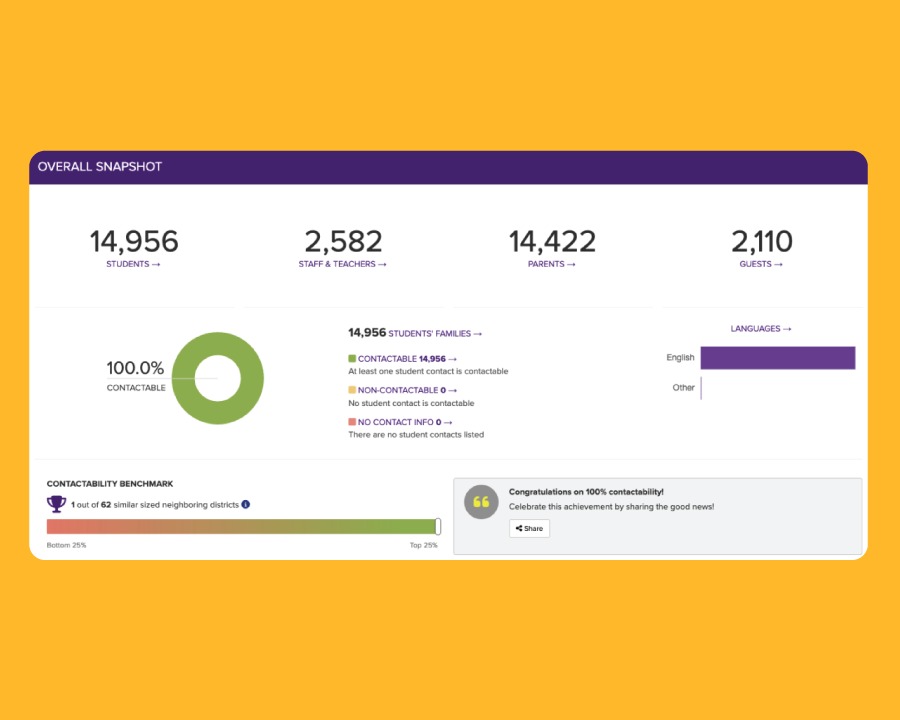
Because ParentSquare is opt-out rather than opt-in, districts start with a higher baseline of reachable families than tools that require families to take action before they can be reached.
“ParentSquare has simplified our district-wide communication by allowing us to know who has and has not received our message. This enables us to be more precise in our approach and query smaller groups for follow-ups.”
Once districts understand their contactability, the next step is identifying what might be preventing them from reaching every family. To build a strong foundation that can be sustained over time, contactability needs to be treated as an ongoing operational practice instead of a one-time project.
When families can’t be contacted, it’s typically because of one of these two reasons:
Since family contact information frequently changes over time, annual data cleanup isn’t enough. Maintaining accurate data requires ongoing attention and continuous improvement.
But in many districts, keeping contact information current requires significant manual effort from school and district staff. Teams spend valuable time tracking down families, updating records, and correcting data issues.
With ParentSquare’s contact verification capabilities, families can confirm or correct their own contact information directly in ParentSquare, while staff have visibility into updates that need action, helping districts improve data quality, reduce manual data cleanup, and maintain communication with more families throughout the year.
“The real game-changer was the contact verification feature, which allowed us to clean up over 5,000 data points in less than a year. For years, I felt like I was yelling into the void, knowing our families did not always maintain correct contacts. Now, we have the data to prove we are actually connecting with our families.”

Successfully delivering messages is an important first step, but reach alone doesn’t create engagement.
A family may receive a message and never open it, or they might open it without engaging with it. Each stage of the communication journey represents a potential point for dropping off:
The first point, between delivery and opening, is often a preference problem. Families are balancing work, school activities, community commitments, and countless daily responsibilities. A message sent through the wrong channel, at the wrong frequency, or in a format that doesn’t work on a family’s device won’t get opened regardless of its content.
ParentSquare is the only platform that lets every family receive school communications without requiring an app download or login—and respond directly by text in their preferred language.
With ParentSquare, families can also set their preferences for how and when they receive posts, alerts, and direct messages, including:
Building these preferences into communication practice makes the reach that districts have worked to achieve more likely to result in engagement.
“ParentSquare has made our communication significantly more efficient and targeted, allowing us to reach the right families with the right message instead of relying on broad, one-size-fits-all emails. It has also increased engagement with families because updates, reminders, and conversations now happen in one accessible, consistent place.”
Preferences determine whether a message is opened, but the next step depends on whether families can understand it.
For districts serving multilingual communities, translation is crucial for every level of communication from district announcements to individual outreach. With ParentSquare, language support includes:
Effective communication requires more than translating outgoing messages. ParentSquare provides two-way translation so families can receive and send messages in their preferred language, even through SMS text messaging without the app.
Even when language isn’t a barrier, clarity can be. A message written at a college reading level or filled with figurative language can make it difficult for families to understand its meaning.
As part of ParentSquare Intelligence, AI rewrite helps teachers and staff rewrite communications in plain language, revise phrasing for clarity, and remove idioms and expressions that don’t carry across languages and cultures—producing clearer source content that improves the accuracy of automatic translations as well.
“The automatic two-way translation is a godsend for our diverse community, and it’s made a noticeable difference. It’s streamlined, efficient, and enhances our connection with parents.”
While being able to reach families with messages they can understand is the most important prerequisite to engagement, actually engagement requires making sure families have opportunities to ask questions, provide feedback, and act on the communication they receive.
To encourage families to participate regularly in dialogue with their schools, ParentSquare enables two-way communication through the channels where they receive all notifications, including text messaging, email, and the app.
To help districts encourage two-way communication with confidence, all direct messages on ParentSquare are tracked and accessible for reference, while AI-powered moderation tools help support productive and respectful conversations without adding administrative burden for staff.

Families who already receive and respond to communication in ParentSquare are also far more likely to complete required actions there. With a unified platform that allows parents to take action directly from the messages they receive, completion rates go up for:
And finally, communication can help extend learning beyond the classroom by inspiring discussion at home. ParentSquare conversation starters help educators provide families with age-appropriate questions and prompts tied to classroom activities and school communications, encouraging meaningful conversations at home and helping families participate more actively in the learning experience.
“By automating targeted reminders, in one of my districts, we achieved a 100% return rate on Chromebooks from our graduating seniors. At one of our middle schools, we successfully recovered 99.84% of overdue books, saving the district thousands of dollars in replacement costs. It’s the perfect example of how streamlined communication directly protects a district’s budget.”
Most districts don’t have a family engagement problem: they have a reachability problem that makes engagement harder to achieve than it needs to be. When contact data is incomplete, communication isn’t accessible, or families don’t have a channel they can use to respond, the gap between effort and outcome widens—no matter how much the district is communicating.
The framework in this guide addresses that gap at every stage:
Districts that follow this framework don’t just communicate more effectively; they collect more forms, see higher event turnout, support better attendance, and build the kind of ongoing family engagement that shows up in student outcomes over time.
“ParentSquare is a powerful community hub that builds vital bridges between school and home. Its seamless translations ensure every family stays connected, fostering true community connectivity.”