



Stay informed with news, updates, and best practices on the ParentSquare blog.
Explore
Core Platform

Solutions for every role in your school community
Built for every type of school and district
See how we solve real challenges facing schools
Insights and ideas that add value to districts
A centralized hub for expert help and guidance

Current as of June 2026

Family engagement funding can come from several federal and state sources, and most districts have more options than they realize.
The range of functionality built into ParentSquare spans communication, attendance, translation, document delivery, payments, and more, which means it aligns with a wide variety of federal and state funding criteria.
This guide details those alignments, explains how ParentSquare maps to the goals behind each funding source, and offers practical guidance for building a funding case that works for your district.
Federal education funding flows through the Every Student Succeeds Act (ESSA), which amended the Elementary and Secondary Education Act (ESEA). ESSA establishes how funds are allocated to states, which in turn determine how local school districts access and use those dollars.
The sections below identify specific areas of ESSA and other federal programs where ParentSquare is an allowable and well-aligned investment. District plans vary, so reviewing your own ESSA Consolidated State Plan and local accountability plan alongside these criteria is a useful starting point.

Title I: Improving the Academic Achievement of the Disadvantaged, Part A
Title I funds are intended to give all children a fair, equitable, and high-quality education and to close achievement gaps. Allowable uses include programs that reach families at home, in the community, and at school, as well as activities that build capacity for family involvement.
Reaching and engaging families is central to what ParentSquare does. SIS integration allows districts to create targeted groups based on grade level, program enrollment, demographics, and more, including McKinney-Vento and Tier 2 MTSS, making it straightforward to deliver communications to the families who need them most.
Title II: Preparing, Training, and Recruiting High-Quality Teachers, Principals, or Other School Leaders, Part A
Title II funds support professional development focused on improving teaching, student learning, and achievement. Allowable activities include training teachers, principals, and other school leaders to effectively engage families and coordinate services between school and community.
Title II can fund staff training on using ParentSquare for family and community engagement. Multiple training formats are available to fit district needs, including:
Ongoing professional development opportunities are also available to help teachers and school leaders build stronger communication practices with families.
Title III: Language Instruction for English Learners and Immigrant Students, Part A
Title III funds promote family and community participation in language instruction programs. Allowable uses include activities that enhance or supplement language instruction for English learners, including parent, family, and community engagement.
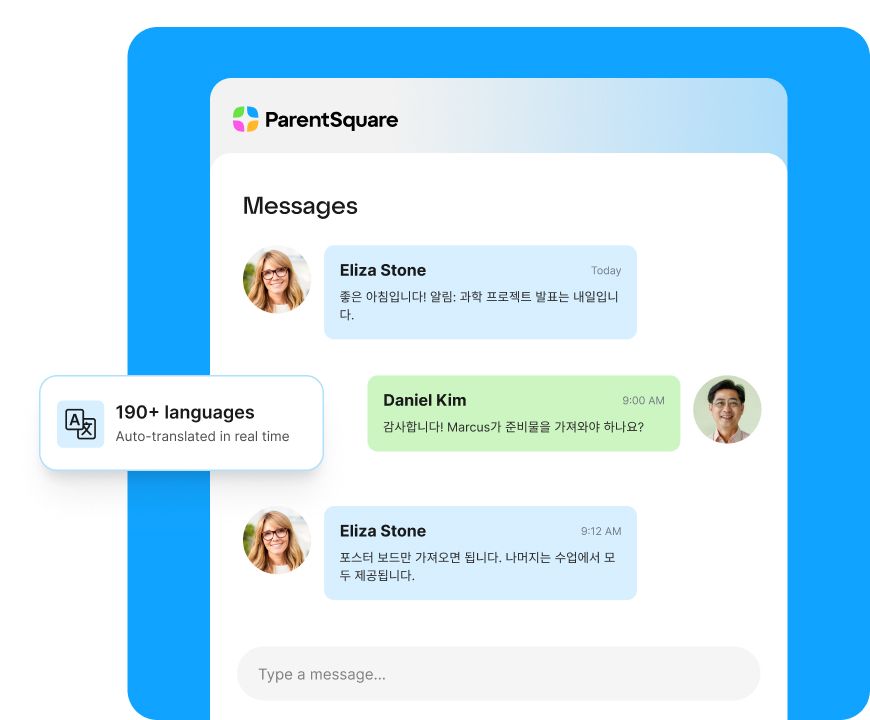
ParentSquare helps connect English learner families to the information and programs they need. With two-way translation into 190+ languages built directly into the platform, ParentSquare removes language barriers across every communication type, including direct messages, media-rich posts, urgent alerts, and permission slips and forms.
See how this district uses ParentSquare for multilingual engagement →
Title IV: 21st Century Schools, Part A, Subpart 1 (Student Support and Academic Enrichment Grants)
Title IV funds are among the most flexible available to districts. SSAE grants support improved school conditions for student learning and more effective use of technology to strengthen academic achievement.
ParentSquare strengthens communication and collaboration between families, students, teachers, and administrators across the entire school community. Some examples include:

For districts that need to justify the investment to a board or finance team, evidence of impact matters as much as funding eligibility. ParentSquare has earned ESSA Level III certification based on a third-party study demonstrating promising evidence of its positive impact on school-family relationship outcomes.
Among the findings:
Level III ESSA certification supports eligibility for various funding sources, especially federal funding, and gives districts a credible, research-backed foundation that ParentSquare is an evidence-based solution.
IDEA establishes the Individuals with Disabilities Education Program, which funds special education and related services for students with disabilities. It supports the development and implementation of Individualized Education Programs (IEPs) and funds technology integration that improves communication among staff, families, and students about IEP progress and ongoing needs.
For districts exploring IDEA funding, allowable uses include technology that streamlines IEP-related communication and documentation, professional development for staff who support students with disabilities, and tools that reduce paperwork burden.

Chronic absenteeism is now part of every state’s accountability framework, and most states have made attendance recovery a named priority in their ESSA Consolidated State Plan. For districts evaluating an attendance solution, this convergence of federal accountability and state priority opens up more funding pathways than many leaders anticipate.
Because attendance intersects with family engagement, MTSS, student services, mental health, and equity, an attendance and communication platform can often draw from multiple funding sources at once.
A practical starting point is to review your state’s ESSA Consolidated Plan and your district’s Local Control and Accountability Plan (LCAP), or its state equivalent. Look specifically for language tied to chronic absenteeism reduction, family engagement, and student well-being.
Several federal funding streams explicitly allow, and in some cases prioritize, spending on attendance interventions and the family engagement tools that drive them.
| Title I, Part A | May be used for parent and family engagement activities, including communications platforms that help schools reach families of chronically absent students. Districts receiving more than $500K in these funds are required to reserve 1% for family engagement and may have flexibility to direct those dollars toward two-way communication tools. |
| Title I, Part D | Supports interventions for students who are chronically absent or at risk of dropping out. |
| Title II, Part A | Can fund professional development for teachers, attendance clerks, and family liaisons on evidence-based attendance interventions and family engagement strategies. |
| Title IV, Part A | One of the most flexible federal funding sources. SSAE grants explicitly support well-rounded education, safe and healthy students, and effective use of technology. ParentSquare can be used to support all three of these based on how the school district engages with parents. |
| Title IV, Part B (21st Century Community Learning Centers) | Supports out-of-school programs, which often include attendance recovery and family outreach components. |
| McKinney-Vento Homeless Education Program | Funds services for students experiencing homelessness, who are chronically absent at significantly higher rates. Communication tools that help districts locate, support, and stay connected with these families are an allowable use. |
| IDEA Part B | Students with disabilities are disproportionately represented among chronically absent students. IDEA funds can support communication and engagement tools that help track attendance, document outreach, and support IEP attendance goals. |
| Full-Service Community Schools Program (FSCS) | Emphasizes coordinated services for students and families, including attendance. |
Most states have also created dedicated funding streams tied to attendance. While specifics vary, common categories include:
| Chronic absenteeism grants and pilot programs | A growing number of states, including New York, Connecticut, Michigan, and Indiana, have launched dedicated chronic absenteeism reduction grants in recent budgets. Check with your state department of education’s attendance or student support office. |
| State accountability and supplemental funds | California districts can use LCFF Supplemental and Concentration funds to address attendance for low-income students, English learners, and foster youth. Illinois districts can apply Evidence-Based Funding toward attendance-related supports. Ohio’s Student Wellness and Success Funds list mentoring, family engagement, and student services tied to attendance as allowable uses. |
| Student mental health and wellness grants | Many states fund school mental health initiatives that connect directly to attendance. Communication platforms that support tiered intervention outreach are often allowable. |
| Truancy intervention and SARB-related funds | Several states provide categorical funding for truancy mediation, school attendance review boards, and early intervention notifications. |
| At-risk and dropout prevention funds | State compensatory education and at-risk student funding can be directed toward attendance technology and family outreach. |
| Local foundation and community partner funding | Education foundations, United Way affiliates, and local health systems are increasingly co-funding chronic absenteeism initiatives alongside districts. |
State-specific grant opportunities change frequently and aren’t covered in detail here. As a general rule, if a state grant has goals similar to Title I, Title IV, or IDEA, ParentSquare almost certainly qualifies.
Use the Attendance Impact Calculator to see how improving attendance can translate into additional state funding (where applicable), as well as students in seats and instructional days recovered.

Finding the right funding sources is only part of the work. The sections below offer guidance on presenting a compelling case to your board and demonstrating results once funding is secured.
The strongest funding presentations connect the investment directly to goals the district has already committed to. When presenting to a board or finance team, districts that make the most compelling case typically:

Once funding is secured, the focus often shifts to demonstrating how spending is delivering against the program’s intent. ParentSquare’s reporting and analytics dashboards help make documentation more manageable for districts, whether reporting back to a federal program, a state agency, or a local grant funder.
With ParentSquare, districts can document and report on:
Federal and state funding isn’t the only path. For districts that have explored those avenues and still need to account for implementation costs, the most practical option is often consolidation: replacing existing platforms and expenditures with ParentSquare.
Because ParentSquare brings so many functions into one platform, districts consolidating their tools find that they can replace costs related to:
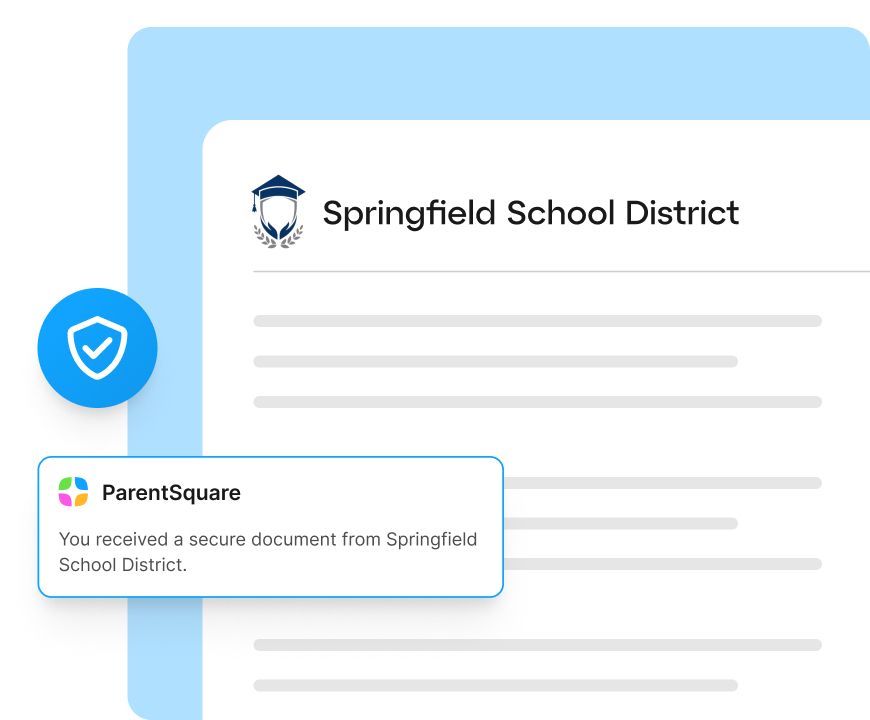
For districts still mailing home report cards, attendance letters, IEPs, or other official documents, Secure Document Delivery can have a fast, measurable impact. Documents are delivered digitally to families through their preferred channels in ParentSquare, and any that go undelivered can be sent to print and mail with a single click.
Common uses include:
Districts have used Secure Document Delivery to eliminate significant printing and postage costs. Cherokee County School District saved $130,000 after rolling the feature out across all 40 schools, while Dysart Unified School District reclaimed 2,300 staff hours annually.
See how other districts have used ParentSquare to save on costs →
Because ParentSquare serves the needs of multiple departments, districts often share the cost across department budgets rather than funding it from a single line. Departments that regularly rely on ParentSquare include:
| Communications and public information | Urgent alerts, broadcast announcements, newsletters, translation, website management, and community outreach |
| Educational services | MTSS family communication and reporting, special education, English learner programs, grade and classroom communications |
| Family engagement | Translation support, barrier removal, event and program participation, family involvement in student learning |
| Human resources | Staff communications with reporting, Secure Document Delivery for staff documents, automated notices, and communication records for documentation purposes |
| Student services | Digital forms and enrollment data, attendance and chronic absenteeism prevention |
| Technology services | Platform rationalization, reduced support burden, district-wide privacy and data governance for all levels of communication |
| Extracurriculars and athletics | Communication for activity groups, volunteer and part-time staff outreach, translation support, family signups and distribution list management |
| PTO/PTA | Outreach to students and families with appropriate permissions, translation support, event signups, and donations |
| Foundations and fundraising | Fundraising event RSVPs, donation campaigns, and volunteer communications with role-based permissions |

Every district’s funding situation is different, but the path forward usually starts with a few targeted conversations. Here’s where to begin:
Questions? Feel free to get in touch with our team for more information.
ParentSquare is the leading family engagement infrastructure helping K-12 districts nationwide reach every family with an award-winning, all-in-one communication platform. Reaching over 22 million students, ParentSquare helps districts consolidate disconnected tools and outdated communication systems with personalized messaging, websites, forms, payments, attendance solutions, and more—in one easy-to-use platform. With powerful features for achieving 100% contactability, two-way translation into 190+ languages, and purpose-built AI enhancements, ParentSquare empowers districts to invite every family to be involved in their student’s education, no matter their home language or the device they use.
Recognized for growth and innovation by Inc. 5000, GSV 150, and more, ParentSquare was founded in 2011 in Santa Barbara, California. Learn more at parentsquare.com.